


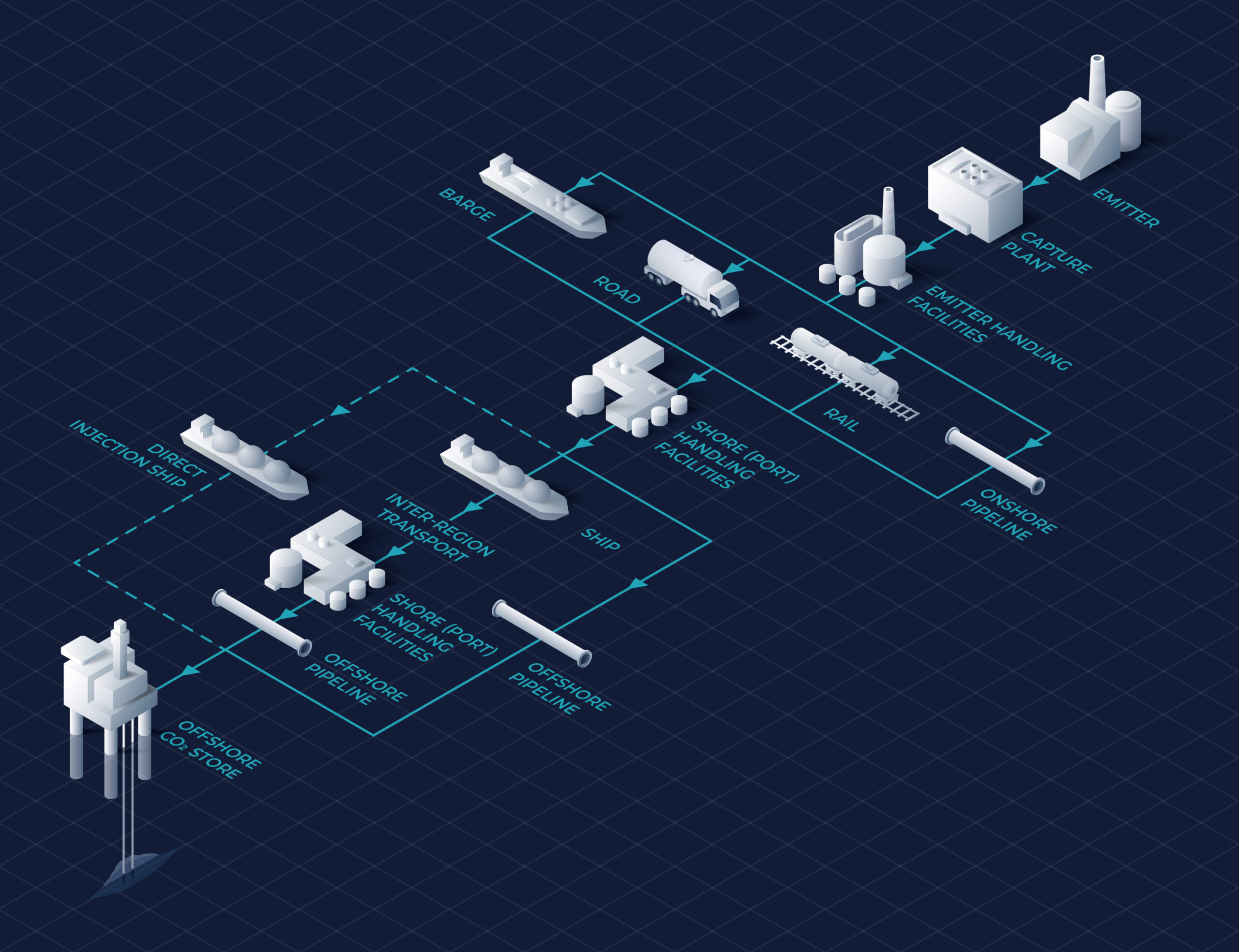
Europe’s ambitions to capture and store carbon at scale depend on transport infrastructure that is yet to be built, with a dedicated fleet of around 65 CO2 carriers and 33 ports needed by 2050, according to a new industry report.
Published by global energy consultancy Xodus, a Subsea7 company, on behalf of the Net Zero Technology Centre (NZTC) and with the support of sponsors EBN, Port of Rotterdam, Gasunie and Offshore Energies UK (OEUK), the CCUS Enabling Infrastructure Study examines the ports, ships and onshore transport needed to move captured carbon dioxide (CO2) from emitters across Europe to offshore storage sites.
Captured emissions across Europe are forecast to grow from 70 million tonnes per annum (MTPA) in 2030 to 320 MTPA by 2050. While the shipping share of the transport market is expected to fall from 48% to 24% over that period as pipeline networks are built out, the volume of CO2 carried by ship is predicted to more than double to 79 MTPA.
The analysis screened roughly 850 operating ports across Europe down to a shortlist of around 200, identifying up to 60 that are particularly well placed to gather captured emissions and route them to offshore geological storage by 2050. Many of the likely dual-purpose ‘emitter’ and ‘store’ ports sit in heavily industrialised areas such as the Port of Rotterdam, Humberside and Liverpool Bay.
James McAreavey, Global Head of CCUS and Special Projects Lead at Xodus, said:
“Most of the technology needed to move captured carbon around Europe already exists. It has been proven over decades in the liquefied petroleum gas (LPG) industry and is in CO2 service today through projects such as Northern Lights. The task now is scaling it.
“Shipping gives emitters early access to offshore storage years before onshore pipeline networks can be consented and built. If investment in ports and vessels starts now, the North Sea can set the benchmark for how the UK and Europe connect emitters to storage.”
The report predicts the European CO2 transport market will evolve as a hybrid system between 2030 and 2050. Pipelines are expected to dominate high-volume, heavily industrialised corridors, while shipping provides flexibility, cross-border connections and a route to decarbonise regions where pipelines would not be competitive.
Cost-based modelling consistently identifies the North Sea as Europe’s primary storage sink across the period, with the UK, Dutch and wider sectors predicted to receive large-scale imports of CO2 from other regions.
Iain Martin, CCUS Technology Manager at NZTC, said
“This study reinforces the strategic importance of enabling infrastructure in scaling CCUS across Europe. As offshore storage demand grows, the North Sea is well placed to serve as the central hub of a connected, cross-border CO₂ transport and storage system.
“Targeted investment in port infrastructure, shipping capacity and storage development will be essential to creating a resilient and commercially viable network. The priority now is to translate this insight into coordinated action that accelerates deployment and strengthens the UK and wider North Sea region’s role in Europe’s decarbonisation ambitions”.
The modelling indicates a fleet of around 22 ships will be required by 2030, growing to 65 by 2050 based on an average cargo capacity of 15,000 tonnes per vessel. These would serve a network of high-throughput ports, supported by a set of regional export sites, and includes around 23 gathering and exporting CO2 from emitters, and 10 receiving it for onward transport to offshore storage.
For the journey from emitter to port, the report finds that road tankers, rail cars and river barges all offer established routes for lower-volume transport, drawing on technologies already proven in the LPG sector. The full report can be accessed at: https://www.xodusgroup.com/media/facbj3ih/ccus-enabling-infrastructure-study-report.pdf